What season is shown in the diagram to the left?
A flavour is a partitioning of the year[1] based on changes in weather condition, ecology, and the number of daylight hours in a given region. On Globe, seasons are the issue of Globe's orbit around the Sun and Globe'due south axial tilt relative to the ecliptic plane.[2] [3] In temperate and polar regions, the seasons are marked by changes in the intensity of sunlight that reaches the Earth's surface, variations of which may cause animals to undergo hibernation or to drift, and plants to be dormant. Various cultures define the number and nature of seasons based on regional variations, and as such there are a number of both modernistic and historical cultures whose number of seasons varies.
The Northern Hemisphere experiences more direct sunlight during May, June, and July, equally the hemisphere faces the Sun. The aforementioned is true of the Southern Hemisphere in Nov, Dec, and January. It is Earth's axial tilt that causes the Sun to be higher in the sky during the summer months, which increases the solar flux. Notwithstanding, due to seasonal lag, June, July, and August are the warmest months in the Northern Hemisphere while Dec, Jan, and February are the warmest months in the Southern Hemisphere.
In temperate and sub-polar regions, four seasons based on the Gregorian calendar are generally recognized: spring, summer, autumn (or autumn), and winter. Ecologists oft employ a six-season model for temperate climate regions which are non tied to any fixed calendar dates: prevernal, vernal, estival, serotinal, autumnal, and hibernal. Many tropical regions have two seasons: the rainy, wet, or monsoon flavor and the dry season. Some take a third cool, mild, or harmattan season. "Seasons" can also be dictated by the timing of important ecological events such as hurricane season, tornado flavor, and wildfire season.[ commendation needed ] Some examples of historical importance are the ancient Egyptian seasons—flood, growth, and depression water—which were previously defined past the former annual flooding of the Nile in Egypt.


Seasons often concur special significance for agrarian societies, whose lives revolve around planting and harvest times, and the change of seasons is often attended by ritual. The definition of seasons is as well cultural. In India, from aboriginal times to the nowadays twenty-four hour period, six seasons or Ritu based on south Asian religious or cultural calendars are recognised and identified for purposes such as agriculture and merchandise.
Causes and effects
Axial tilt

Illumination of Globe at each change of astronomical flavour

The seasons result from the Earth'due south axis of rotation being tilted with respect to its orbital airplane by an angle of approximately 23.iv degrees.[4] (This tilt is also known as "obliquity of the ecliptic".)
Regardless of the time of year, the northern and southern hemispheres always feel contrary seasons. This is because during summer or wintertime, one office of the planet is more than directly exposed to the rays of the Dominicus than the other, and this exposure alternates as the World revolves in its orbit. For approximately half of the year (from around March20 to around September22), the Northern Hemisphere tips toward the Sun, with the maximum amount occurring on virtually June21. For the other half of the year, the same happens, only in the Southern Hemisphere instead of the Northern, with the maximum around December21. The two instants when the Sun is direct overhead at the Equator are the equinoxes. Also at that moment, both the North Pole and the Due south Pole of the Earth are just on the terminator, and hence day and dark are every bit divided between the two hemispheres. Effectually the March equinox, the Northern Hemisphere will be experiencing spring as the hours of daylight increase, and the Southern Hemisphere is experiencing autumn every bit daylight hours shorten.
The effect of axial tilt is observable as the change in 24-hour interval length and altitude of the Sun at solar apex (the Sun's culmination) during the year. The depression bending of Sun during the winter months means that incoming rays of solar radiation are spread over a larger expanse of the Earth's surface, so the light received is more indirect and of lower intensity. Between this result and the shorter daylight hours, the axial tilt of the Earth accounts for about of the seasonal variation in climate in both hemispheres.
-

Illumination of World by Sun at the northern solstice.
-
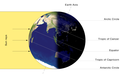
Illumination of World past Dominicus at the southern solstice.
-
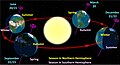
Diagram of the Earth's seasons equally seen from the northward. Far right: southern solstice
-
Animation of Globe as seen daily from the Lord's day looking at UTC+02:00, showing the solstice and changing seasons.
-

2 images showing the amount of reflected sunlight at southern and northern summer solstices respectively (watts / thousandii).
Elliptical Earth orbit
Compared to axial tilt, other factors contribute fiddling to seasonal temperature changes. The seasons are non the consequence of the variation in Globe'southward distance to the Sunday because of its elliptical orbit.[five] In fact, Earth reaches perihelion (the point in its orbit closest to the Sunday) in January, and it reaches aphelion (the indicate farthest from the Sunday) in July, so the slight contribution of orbital eccentricity opposes the temperature trends of the seasons in the Northern Hemisphere.[six] In full general, the effect of orbital eccentricity on Earth'south seasons is a 7% variation in sunlight received.
Orbital eccentricity can influence temperatures, but on Earth, this upshot is pocket-sized and is more than than counteracted by other factors; enquiry shows that the Earth every bit a whole is actually slightly warmer when farther from the dominicus. This is because the Northern Hemisphere has more country than the Southern, and land warms more readily than sea.[half dozen] Any noticeable intensification of southern winters and summers due to Earth'south elliptical orbit is mitigated by the affluence of h2o in the Southern Hemisphere.[7]
Maritime and hemispheric
Seasonal weather fluctuations (changes) also depend on factors such equally proximity to oceans or other big bodies of water, currents in those oceans, El Niño/ENSO and other oceanic cycles, and prevailing winds.
In the temperate and polar regions, seasons are marked by changes in the corporeality of sunlight, which in plough often causes cycles of dormancy in plants and hibernation in animals. These effects vary with latitude and with proximity to bodies of water. For example, the South Pole is in the middle of the continent of Antarctica and therefore a considerable distance from the moderating influence of the southern oceans. The North Pole is in the Arctic Ocean, and thus its temperature extremes are buffered past the water. The effect is that the South Pole is consistently colder during the southern winter than the North Pole during the northern winter.
The seasonal cycle in the polar and temperate zones of ane hemisphere is opposite to that of the other. When it is summer in the Northern Hemisphere, it is wintertime in the Southern, and vice versa.
Tropics
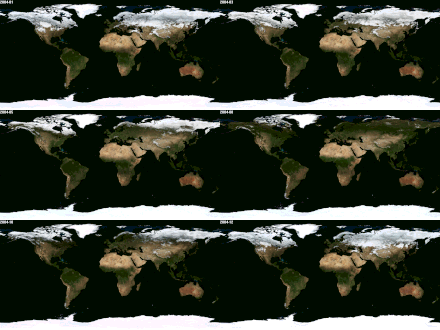
Animation of seasonal differences especially snow cover through the year
The tropical and subtropical regions come across little annual fluctuation of sunlight. However, seasonal shifts occur forth a rainy, depression-pressure chugalug chosen the Intertropical Convergence Zone (ICZ). As a result, the amount of precipitation tends to vary more than dramatically than the average temperature. When the Zone is north of the Equator, the northern tropics feel their moisture season while the southern tropics have their dry season. This pattern reverses when the Zone migrates to a position due south of the Equator.
Mid-latitude thermal lag
In meteorological terms, the solstices (the maximum and minimum insolation) do not autumn in the middles of summertime and wintertime. The heights of these seasons occur upwards to 7 weeks later because of seasonal lag. Seasons, though, are not always divers in meteorological terms.
In astronomical reckoning past hours of daylight lone, the solstices and equinoxes are in the middle of the corresponding seasons. Because of seasonal lag due to thermal absorption and release past the oceans, regions with a continental climate, which predominate in the Northern Hemisphere, often consider these iv dates to exist the start of the seasons as in the diagram, with the cross-quarter days considered seasonal midpoints. The length of these seasons is not compatible because of Earth's elliptical orbit and its different speeds along that orbit.[eight]
Four-season reckoning
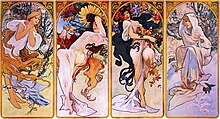
Well-nigh calendar-based partitions use a four-flavor model to demarcate the warmest and coldest seasons, which are further separated by two intermediate seasons. Calendar-based reckoning defines the seasons in relative rather than absolute terms, then the coldest quarter-year is considered winter fifty-fifty if floral activity is regularly observed during information technology, despite the traditional association of flowers with jump and summertime. The major exception is in the torrid zone where, as already noted, the winter flavor is not observed.
The four seasons have been in utilize since at least Roman times, every bit in Rerum rusticarum of Varro[9] Varro says that leap, summer, autumn, and winter start on the 23rd solar day of the dominicus's passage through Aquarius, Taurus, Leo, and Scorpio, respectively. 9 years before he wrote, Julius Caesar had reformed the agenda, so Varro was able to assign the dates of February 7, May nine, Baronial 11, and Nov 10 to the start of spring, summertime, autumn, and winter.
Official
As noted, a diverseness of dates and even exact times are used in unlike countries or regions to mark changes of the calendar seasons. These observances are oftentimes declared "official" within their corresponding areas by the local or national media, even when the weather or climate is contradictory.[10] Nevertheless, they are mainly a thing of custom but, and take not by and large been proclaimed by governments north or south of the equator for civil purposes.[11] [12]
Meteorological

Four temperate and subpolar seasons: (above) winter, spring, (beneath) summertime, autumn/autumn
Meteorological seasons are reckoned by temperature, with summer existence the hottest quarter of the yr and winter the coldest quarter of the year. In 1780 the Societas Meteorologica Palatina (which became defunct in 1795), an early international organization for meteorology, defined seasons every bit groupings of three whole months equally identified past the Gregorian calendar. Ever since, professional meteorologists all over the world have used this definition.[13] Therefore, for temperate areas in the northern hemisphere, spring begins on one March, summer on 1 June, autumn on ane September, and winter on ane December. For the southern hemisphere temperate zone, bound begins on ane September, summer on 1 December, fall on i March, and winter on ane June.[14] [xv] In Australasia the meteorological terms for seasons utilize to the temperate zone that occupies all of New Zealand, New Due south Wales, Victoria, Tasmania, the south-eastern corner of Southward Commonwealth of australia and the south-west of Western Commonwealth of australia, and the due south east Queensland areas south of Brisbane.
| Northern hemisphere | Southern hemisphere | Start engagement | End date |
|---|---|---|---|
| Winter | Summer | 1 Dec | 28 February (29th if leap yr) |
| Spring | Autumn | 1 March | 31 May |
| Summer | Wintertime | 1 June | 31 August |
| Autumn | Spring | 1 September | 30 Nov |
In Sweden and Finland, meteorologists and news outlets use the concept of thermal seasons, which are divers based on mean daily temperatures.[16] The starting time of spring is defined every bit when the mean daily temperature permanently rises above 0 °C. The beginning of summer is divers as when the temperature permanently rises to a higher place +10 °C, fall as when the temperature permanently falls beneath +10 °C, and wintertime as when the temperature permanently falls below 0 °C. In Finland, "permanently" is defined as when the hateful daily averaged temperature remains above or below the defined limit for 7 sequent days. (In Sweden the number of days ranges from v to 7 depending on the season.) This implies two things:
- the seasons do not begin on fixed dates and must be determined by observation and are known only after the fact,
- the seasons begin on different dates in unlike parts of the country.
| Surface air temperature | |
|---|---|
| | |
| Diagram was calculated (abscisse: the 21st of each month). Calculation based on data published by Jones et al.[17] | The picture shows Figure 7 as published by Jones et al.[17] |
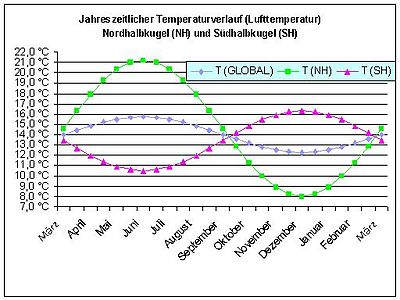
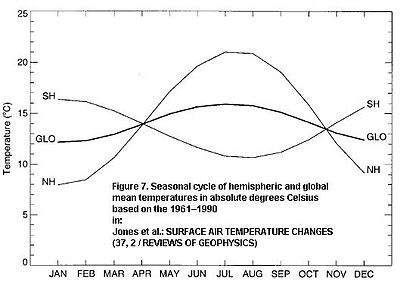
The India Meteorological Department (IMD) designates four climatological seasons:[18]
- Wintertime, occurring from December to Feb. The year's coldest months are December and January, when temperatures average effectually x–15 °C (50–59 °F) in the northwest; temperatures rise as one proceeds towards the equator, peaking effectually 20–25 °C (68–77 °F) in mainland Bharat's southeast.
- Summer or pre-monsoon flavour, lasting from March to May. In western and southern regions, the hottest month is April; for northern regions of India, May is the hottest month. Temperatures average around 32–40 °C (90–104 °F) in about of the interior.
- Monsoon or rainy season, lasting from June to September. The flavor is dominated past the humid southwest summertime monsoon, which slowly sweeps beyond the state beginning in tardily May or early on June. Monsoon rains begin to recede from North Republic of india at the beginning of October. South Republic of india typically receives more rainfall.
- Post-monsoon or autumn season, lasting from October to Nov. In the northwest of Bharat, Oct and November are unremarkably cloudless. Tamil Nadu receives most of its annual precipitation in the northeast monsoon season.
Astronomical
| event | equinox | solstice | equinox | solstice | ||||
|---|---|---|---|---|---|---|---|---|
| month | March | June | September | December | ||||
| year | 24-hour interval | time | day | time | day | time | day | fourth dimension |
| 2017 | 20 | x:29 | 21 | 04:25 | 22 | 20:02 | 21 | 16:29 |
| 2018 | 20 | 16:15 | 21 | 10:07 | 23 | 01:54 | 21 | 22:22 |
| 2019 | xx | 21:58 | 21 | fifteen:54 | 23 | 07:l | 22 | 04:19 |
| 2020 | 20 | 03:50 | 20 | 21:43 | 22 | thirteen:31 | 21 | x:03 |
| 2021 | twenty | 09:37 | 21 | 03:32 | 22 | 19:21 | 21 | fifteen:59 |
| 2022 | 20 | fifteen:33 | 21 | 09:fourteen | 23 | 01:04 | 21 | 21:48 |
| 2023 | 20 | 21:25 | 21 | 14:58 | 23 | 06:fifty | 22 | 03:28 |
| 2024 | 20 | 03:07 | 20 | twenty:51 | 22 | 12:44 | 21 | 09:twenty |
| 2025 | twenty | 09:02 | 21 | 02:42 | 22 | 18:20 | 21 | fifteen:03 |
| 2026 | 20 | 14:46 | 21 | 08:25 | 23 | 00:06 | 21 | xx:50 |
| 2027 | twenty | xx:25 | 21 | 14:11 | 23 | 06:02 | 22 | 02:43 |
Astronomical timing every bit the basis for designating the temperate seasons dates back at least to the Julian Calendar used past the ancient Romans. As mentioned above, Varro wrote that spring, summer, fall, and wintertime start on the 23rd solar day of the sun's passage through Aquarius, Taurus, Leo, and Scorpio, respectively, and that (in the Julian Agenda) these days were Feb vii, May 9, August 11, and November ten. He points out that the lengths are non equal, being 91 (in non-leap years), 94, 91, and 89 days for spring, summer, fall, and winter.[nine] The midpoints of these seasons were March 24 or 25, June 25, September 25 or 26, and December 24 or 25, which stand for to the equinoctes and solstices of his twenty-four hour period.
Nowadays the astronomical timing has winter starting at the winter solstice, spring at the leap equinox, and then on. This is used worldwide, although some countries like Australia, New Zealand,[21] Pakistan and Russia adopt to use meteorological reckoning. The precise timing of the seasons is determined by the exact times of the sun reaching the tropics of Cancer and Capricorn for the solstices and the times of the dominicus's transit over the equator for the equinoxes, or a traditional date close to these times.[22]
The post-obit diagram shows the relation betwixt the line of solstice and the line of apsides of World's elliptical orbit. The orbital ellipse (with eccentricity exaggerated for effect) goes through each of the vi Globe images, which are sequentially the perihelion (periapsis—nearest point to the lord's day) on anywhere from 2 January to five January, the point of March equinox on nineteen, 20 or 21 March, the indicate of June solstice on 20 or 21 June, the aphelion (apoapsis—farthest point from the lord's day) on anywhere from 3 July to 6 July, the September equinox on 22 or 23 September, and the December solstice on 21 or 22 December.

Note: Distances are exaggerated and non to calibration
These "astronomical" seasons are non of equal length, considering of the elliptical nature of the orbit of the Earth, as discovered by Johannes Kepler. From the March equinox it currently takes 92.75 days until the June solstice, then 93.65 days until the September equinox, 89.85 days until the Dec solstice and finally 88.99 days until the March equinox. Thus the time from the March equinox to the September equinox is vii.56 days longer than from the September equinox to the March equinox.
Variation due to calendar misalignment
The times of the equinoxes and solstices are not fixed with respect to the modernistic Gregorian calendar, but autumn about half-dozen hours afterward every twelvemonth, amounting to 1 full day in iv years. They are reset by the occurrence of a jump twelvemonth. The Gregorian calendar is designed to keep the March equinox no later than 21 March as accurately as is applied. Also see: Gregorian calendar seasonal error.
The calendar equinox (used in the calculation of Easter) is 21 March, the aforementioned date as in the Easter tables current at the time of the Quango of Nicaea in Ad 325. The calendar is therefore framed to forbid the astronomical equinox wandering onto 22 March. From Nicaea to the engagement of the reform, the years 500, 600, 700, 900, 1000, 1100, 1300, 1400, and 1500, which would not accept been leap years in the Gregorian calendar, amount to ix actress days, but astronomers directed that x days be removed. Because of this, the {proleptic) Gregorian calendar agrees with the Julian calendar in the third century of the Christian era, rather than in the quaternary.
Currently, the most common equinox and solstice dates are March 20, June 21, September 22 or 23, and Dec 21; the four-year average slowly shifts to before times equally a century progresses. This shift is a full twenty-four hours in about 128 years (compensated mainly by the century "leap twelvemonth" rules of the Gregorian calendar); as 2000 was a leap year, the current shift has been progressing since the beginning of the last century, when equinoxes and solstices were relatively late. This also means that in many years of the twentieth century, the dates March 21, June 22, September 23, and December 22 were much more than common, so older books teach (and older people may still remember) these dates.
Annotation that all the times are given in UTC (roughly speaking, the time at Greenwich, ignoring British Summer Time). People living farther to the eastward (Asia and Australia), whose local times are in advance, meet the astronomical seasons evidently start later; for example, in Tonga (UTC+13), an equinox occurred on September 24, 1999, a appointment on which the equinox volition non fall once again until 2103. On the other paw, people living far to the west (America), whose clocks run behind UTC, may experience an equinox as early every bit March nineteen.
Change over time
Over thousands of years, the Earth's centric tilt and orbital eccentricity vary (come across Milankovitch cycles). The equinoxes and solstices motion west relative to the stars while the perihelion and aphelion move eastward. Thus, x thousand years from now Globe'south northern winter will occur at aphelion and northern summer at perihelion. The severity of seasonal change — the average temperature deviation between summer and winter in location — will besides modify over time because the Earth'due south axial tilt fluctuates between 22.one and 24.5 degrees.
Smaller irregularities in the times are acquired by perturbations of the Moon and the other planets.
Solar
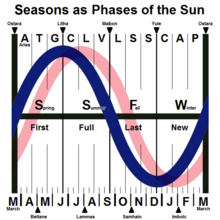
The annual wheel of insolation (Sunday energy, shown in blueish) with primal points for seasons (heart), quarter days (meridian) and cross-quarter days (bottom) forth with months (lower) and Zodiac houses (upper). The cycle of temperature (shown in pinkish) is delayed by seasonal lag.
Solar timing is based on insolation in which the solstices and equinoxes are seen equally the midpoints of the seasons. This was the instance with the seasons described by the Roman scholar Varro (see higher up). It was the method for reckoning seasons in medieval Europe, especially by the Celts, and is nevertheless ceremonially observed in Ireland and some East Asian countries. Summertime is divers as the quarter of the year with the greatest insolation and wintertime as the quarter with the least.
The solar seasons change at the cross-quarter days, which are near three–four weeks earlier than the meteorological seasons and 6–7 weeks earlier than seasons starting at equinoxes and solstices. Thus, the day of greatest insolation is designated "midsummer" as noted in William Shakespeare's play A Midsummer Nighttime'southward Dream, which is attack the summer solstice. On the Celtic calendar, the first of the seasons corresponds to four Infidel agricultural festivals - the traditional commencement day of wintertime is 1 November (Samhain, the Celtic origin of Halloween); spring starts 1 February (Imbolc, the Celtic origin of Groundhog Solar day); summer begins 1 May (Beltane, the Celtic origin of May Twenty-four hour period); the first day of autumn is 1 August (Celtic Lughnasadh).
| Season | Start date | End date |
|---|---|---|
| Winter | 1 November (All Saints' Solar day) | 31 January |
| Spring | 1 February (St. Brigid's Solar day) | 30 April |
| Summer | 1 May (May Day) | 31 July |
| Autumn | i Baronial (Lughnasadh) | 31 October (Hallowe'en) |
Solar terms
The traditional calendar in China has 4 seasons based on 24 periods known as solar terms.[23] The four seasons chūn ( 春 ), xià ( 夏 ), qiū ( 秋 ), and dōng ( 冬 )—universally translated as "spring", "summertime", "fall", and "winter"—each center around the respective solstice or equinox. Astronomically, the seasons are said to begin on Lichun ( 立春 , "the start of bound") on about 4 Feb, Lixia ( 立夏 ) on about 6 May, Liqiu ( 立秋 ) on about 8 August, and Lidong ( 立冬 ) on about 7 November. These dates were not part of the traditional lunar calendar, however, and moveable holidays such as Chinese New Year and the Mid-Fall Festival are more closely associated with the seasons. Information technology forms the ground of other such systems in East Asian lunisolar calendars.
Six-season reckoning
Some calendars in south asia use a six-season segmentation where the number of seasons between summer and winter tin can number from one to three. The dates are fixed at even intervals of months.
In the Hindu calendar of tropical and subtropical Republic of india, there are six seasons or Ritu that are calendar-based in the sense of having fixed dates: Vasanta (spring), Greeshma (summertime), Varsha (monsoon), Sharad (fall), Hemanta (early on winter), and Shishira (prevernal or tardily winter). The six seasons are ascribed to ii months each of the twelve months in the Hindu calendar. The rough correspondences are:
| Hindu season | Start | Terminate | Hindu months | Mapping to English names |
|---|---|---|---|---|
| Vasanta | Mid-March | Mid-May | Chaitra, Vaishakha | spring |
| Greeshma | Mid-May | Mid-July | Jyeshtha, Ashadha | summer |
| Varshā | Mid-July | Mid-September | Shraavana, Bhadrapada | monsoon |
| Sharad | Mid-September | Mid-November | Ashvin, Kartika | autumn |
| Hemant | Mid-November | Mid-January | Maargashirsha, Pushya | early winter |
| Shishir | Mid-January | Mid-March | Magh, Phalguna | prevernal or late winter |
The Bengali Agenda is like but differs in start and finish times. It has the following seasons or ritu:
| Bengali season (ঋতু) | Start | End | Bengali months | Mapping to English language names |
|---|---|---|---|---|
| Bôsônto বসন্ত(leap) | Mid-Feb | Mid-April | Falgun, Choitro | Spring |
| Greeshmo (গ্রীষ্ম)(summertime) | Mid-April | Mid-June | Boishakh, Joishtho | Summer |
| Bôrsha (বর্ষা) (monsoon) | Mid-June | Mid-August | Asharh, Srabon | Monsoon |
| Shôrôt (শরৎ) (autumn/ fall) | Mid-August | Mid-October | Bhadro, Ashwin | Autumn |
| Hemônto (হেমন্ত) (frost/ tardily autumn) | Mid-October | Mid-December | Kartik, Ogrohayon | Belatedly Autumn |
| Sheet (শীত) (wintertime) | Mid-December | Mid-February | Poush, Magh | Wintertime |
The Odia Calendar is like but differs in start and end times.
| Odia Flavour (ଋତୁ) | Season | Odia months | Gregorian |
|---|---|---|---|
| ଗ୍ରୀଷ୍ମ Grīṣmå | Summer | Båiśākhå–Jyeṣṭhå | April–June |
| ବର୍ଷା Bårṣā | Monsoon | Āṣāṛhå–Śrābåṇ | June–August |
| ଶରତ Śåråt | Fall | Bhādråb–Āświn | August–October |
| ହେମନ୍ତ Hemåntå | Pre-Wintertime | Kārtik–Mārgåśir | October–December |
| ଶୀତ Śīt | Winter | Pouṣå–Māghå | December–Feb |
| ବସନ୍ତ Båsåntå | Spring | Fālgun–Chåitrå | February–April |
The Tamil agenda follows a similar blueprint of six seasons
| Tamil season | Gregorian months | Tamil months |
|---|---|---|
| MuthuVenil (summertime) | April 15 to June 14 | Chithirai and Vaikasi |
| Kaar (monsoon) | June xv to Baronial 14 | Aani and Aadi |
| Kulir (autumn) | August 15 to October 14 | Avani and Purattasi |
| MunPani (winter) | Oct fifteen to December 14 | Aipasi and Karthikai |
| PinPani (prevernal) | December xv to February 14 | Margazhi and Thai |
| IlaVenil (spring) | February 15 to April fourteen | Maasi and Panguni |
Not-agenda-based reckoning
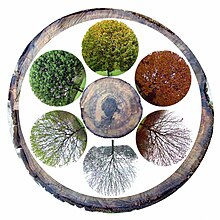
The six modern mid-latitude ecological seasons.
From bottom, clockwise:
prevernal, vernal, estival, serotinal, autumnal, hibernal
Seasonal changes regarding a tree over a year
Ecologically speaking, a flavor is a period of the yr in which only certain types of floral and animal events happen (e.one thousand.: flowers bloom—jump; hedgehogs hibernate—winter). So, if we can notice a alter in daily floral and animal events, the season is changing. In this sense, ecological seasons are defined in accented terms, different calendar-based methods in which the seasons are relative. If specific conditions associated with a particular ecological season don't usually occur in a detail region, then that area cannot be said to experience that season on a regular basis.
In U.k., the onset of spring used to exist defined[ when? ] as when the maximum daily temperature reached 50 °F (10 °C) in a defined sequence of days. This almost ever occurred in March. Yet, with global warming this temperature is now not uncommon in the winter.[ citation needed ]
Modern mid-latitude ecological
Six ecological seasons can be distinguished without stock-still calendar-based dates like the meteorological and astronomical seasons.[24] Oceanic regions tend to feel the offset of the hibernal flavor upward to a month later than continental climates. Conversely, prevernal and vernal seasons begin upwards to a month earlier almost oceanic and coastal areas. For example, prevernal crocus blooms typically appear as early as February in coastal areas of British Columbia, the British Isles, but more often than not don't appear until March or April in locations like the Midwest USA or parts of eastern Europe. The actual dates for each flavour vary by climate region and tin shift from one year to the next. Average dates listed hither are for mild and cool temperate climate zones in the Northern Hemisphere:
- Prevernal (early or pre-bound): Begins February (mild temperate), to March (cool temperate). Deciduous tree buds begin to peachy. Some types of migrating birds fly from winter to summer habitats.
- Vernal (bound): Begins mid March (mild temperate), to late April (cool temperate). Tree buds burst into leaves. Birds establish territories and begin mating and nesting.
- Estival (high summer): Begins June in nigh temperate climates. Trees in total leaf. Birds hatch and raise offspring.
- Serotinal (tardily summertime): Generally begins mid to late Baronial. Deciduous leaves brainstorm to alter colour in higher latitude locations (above 45 n). Young birds reach maturity and join other adult birds preparing for fall migration. The traditional "harvest flavor" begins by early on September.
- Autumnal (autumn): By and large begins mid to late September. Tree leaves in full color and then plow brown and fall to the ground. Birds migrate dorsum to wintering areas.
- Hibernal (winter): Begins Dec (mild temperate), Nov (cool temperate). Deciduous copse are bare and fallen leaves begin to disuse. Migrating birds settled in wintertime habitats.
Ethnic ecological
Indigenous people in polar, temperate and tropical climates of northern Eurasia, the Americas, Africa, Oceania, and Australia accept traditionally defined the seasons ecologically by observing the activity of the plants, animals and weather around them. Each dissever tribal group traditionally observes different seasons determined according to local criteria that can vary from the hibernation of polar bears on the chill tundras to the growing seasons of plants in the tropical rainforests. In Australia, some tribes take up to eight seasons in a yr,[14] as do the Sami people in Scandinavia. Many indigenous people who no longer live straight off the land in traditional often nomadic styles, now observe modern methods of seasonal reckoning according to what is customary in their particular land or region.
The N American Cree and possibly other Algonquian speaking peoples used or notwithstanding use a half-dozen-season organisation. The extra two seasons denoting the freezing and breaking up of the ice on rivers and lakes.[25]
| Cree season | Approximate months | English translation |
|---|---|---|
| Pipon | Jan/Feb | Winter |
| Sekwun | Mar/Apr | Break-up |
| Mithoskumin | May/Jun | Spring |
| Nepin | Jul/Aug | Summertime |
| Tukwakin | Sep/Oct | Fall |
| Mikiskaw | Nov/Dec | Freeze-up |
The Noongar people of South-West Western Australia recognise maar-keyen bonar,[26] or half-dozen seasons. Each season's arrival is heralded not by a calendar date, but by environmental factors[27] such as irresolute winds, flowering plants, temperature and migration patterns and lasts approximately ii standard calendar months. The seasons also correlate to aspects of the homo condition, intrinsically linking the lives of the people to the world that surrounds them and also dictating their movements, equally with each flavor, diverse parts of state would be visited which were particularly arable or safe from the elements.[28]
| Noongar season | Approximate months | Cultural parallel |
|---|---|---|
| Birak (commencement summertime) | December to Jan | Season of the young |
| Bunuru (second summer) | February to March | Season of adolescence |
| Djeran (autumn) | April to May | Flavor of adulthood |
| Makuru (the first rains) | June to July | Fertility season |
| Djilba (the second rains) | Baronial to September | Flavor of conception |
| Kambarang (wildflower season) | October to November | Season of birth |
Tropical

Two seasons
In the torrid zone, where seasonal dates besides vary, information technology is more common to speak of the rainy (or wet, or monsoon) season versus the dry flavor. For example, in Nicaragua the dry season (November to April) is chosen "summer" and the rainy season (May to Oct) is called "winter", even though information technology is located in the northern hemisphere. In that location is no noticeable change in the amount of sunlight at different times of the year. However, many regions (such every bit the northern Indian body of water) are subject to monsoon rain and wind cycles.
Floral and creature action variation near the equator depends more on wet/dry cycles than seasonal temperature variations, with different species flowering (or emerging from cocoons) at specific times before, during, or subsequently the monsoon season. Thus, the tropics are characterized by numerous "mini-seasons" within the larger seasonal blocks of time.
In the tropical parts of Australia in the northern parts of Queensland, Western Australia, and the Northern Territory, wet and dry seasons are observed in improver to or in place of temperate flavor names.[29]
| Northern Hemisphere | Southern Hemisphere | Start appointment | End date |
|---|---|---|---|
| Dry out flavor | Wet season | 1 November | xxx Apr |
| Wet flavour | Dry flavor | 1 May | 31 Oct |
Three seasons
The about historically important of these are the three seasons—alluvion, growth, and low water—which were previously defined past the sometime annual flooding of the Nile in Arab republic of egypt. In some tropical areas a 3-mode division into hot, rainy, and absurd season is used. In Thailand three seasons are recognised [30]
| Thai season | Months |
|---|---|
| Ruedu nao (common cold flavor) | mid October to mid February |
| Ruedu ron (hot season) | mid February to mid May |
| Ruedu fon (rainy flavour) | mid May to mid October |
Polar
Whatsoever point north of the Arctic Circumvolve or south of the Antarctic Circle volition take ane menstruation in the summer chosen "polar twenty-four hours" when the dominicus does non set, and one period in the wintertime chosen 'polar night' when the dominicus does not rising. At progressively college latitudes, the maximum periods of "midnight dominicus" and "polar night" are progressively longer.
For instance, at the military and atmospheric condition station Alert located at 82°30′05″N and 62°20′20″Westward, on the northern tip of Ellesmere Island, Canada (about 450 nautical miles or 830 km from the North Pole), the sun begins to peek above the horizon for minutes per 24-hour interval at the end of February and each day it climbs higher and stays upward longer; by 21 March, the sun is up for over 12 hours. On six April the sun rises at 0522 UTC and remains above the horizon until it sets below the horizon once again on half-dozen September at 0335 UTC. By Oct 13 the sun is above the horizon for simply 1 hour 30 minutes, and on October 14 it does not rise higher up the horizon at all and remains below the horizon until it rises once again on 27 February.[31]
Commencement lite comes in belatedly January because the sky has twilight, being a glow on the horizon, for increasing hours each 24-hour interval, for more than than a month earlier the dominicus commencement appears with its disc higher up the horizon. From mid-November to mid-January, there is no twilight.
In the weeks surrounding 21 June, in the northern polar region, the sun is at its highest top, appearing to circumvolve the heaven there without going below the horizon. Somewhen, it does go beneath the horizon, for progressively longer periods each mean solar day until around the middle of Oct, when it disappears for the last time until the following Feb. For a few more weeks, "day" is marked by decreasing periods of twilight. Eventually, from mid-November to mid-Jan, there is no twilight and it is continuously dark. In mid January the first faint wash of twilight briefly touches the horizon (for only minutes per 24-hour interval), and and so twilight increases in duration with increasing brightness each day until sunrise at end of Feb, and so on six April the sun remains above the horizon until mid Oct.
War machine campaigning seasons
Seasonal atmospheric condition and climate atmospheric condition tin can become important in the context of military operations. Seasonal reckoning in the armed services of whatsoever country or region tends to be very fluid and based mainly on short to medium term weather conditions that are independent of the calendar.
For navies, the presence of accessible ports and bases can allow naval operations during certain (variable) seasons of the year. The availability of ice-free or warm-water ports can make navies much more effective. Thus Russia, historically navally constrained when confined to using Arkhangelsk (before the 18th century) and even Kronstadt, has particular interests in maintaining and in preserving admission to Baltiysk, Vladivostok, and Sevastopol.[32] Storm seasons or polar winter-atmospheric condition conditions can inhibit surface warships at bounding main.
Pre-modern armies, specially in Europe, tended to entrada in the summer months - peasant conscripts tended to melt away at harvest time, nor did it make economic sense in an agricultural society to neglect the sowing season.[33] Any mod state of war of manouevre profits from house basis - summer can provide dry conditions suitable for marching and transport, frozen snowfall in wintertime can likewise offer a reliable surface for a period, but bound thaws or autumn rains tin can inhibit campaigning. Rainy-season floods may make rivers temporarily impassable, and wintertime snow tends to cake mountain passes. Taliban offensives are usually bars to the Afghan Fighting Season.
See also
- Horae, Greek goddesses of seasons
- Indian summer
- Persephone, Greek mythological figure associated with the rebirth of vegetation in the spring
- Sun path
- Vertumnus, Roman god of the seasons
Notes
References
- ^ "Definition of SEASON". www.merriam-webster.com . Retrieved 27 April 2018.
- ^ Khavrus, V.; Shelevytsky, I. (2010). "Introduction to solar motion geometry on the basis of a elementary model". Physics Education. 45 (half-dozen): 641–653. Bibcode:2010PhyEd..45..641K. doi:10.1088/0031-9120/45/6/010. Archived from the original on 2016-09-xvi. Retrieved 2011-05-13 .
- ^ Khavrus, 5.; apple, I. (2012). "Geometry and the physics of seasons". Physics Education. 47 (6): 680–692. doi:10.1088/0031-9120/47/six/680.
- ^ Cain, Fraiser. "Tilt of the Earth". Retrieved two May 2014.
- ^ "Fundamentals of concrete geography", PhysicalGeography.net, Ch. 6: Free energy and Matter:(h) Earth-Sun Geometry, [ane]
- ^ a b Phillips, Tony (July 4, 2003). "The Distant Sun". NASA . Retrieved Apr 21, 2021.
- ^ Phillips, Tony. "Earth at Perihelion". Science News. NASA. Retrieved 14 May 2013.
- ^ "Astronomy Answers AstronomyAnswerBook: Seasons," Astronomical Plant, Utrecht Academy, downloaded one August 2008
- ^ a b De Re Rustica 28. Latin original.
- ^ CBC News Canada (2013). "Canadians brace for a cold spring first". CBC News. Retrieved 2014-x-01 .
- ^ "When practise the four seasons officially brainstorm?". National Concrete Laboratory. 2007. Retrieved 2014-10-01 .
- ^ "How are the dates of the four seasons worked out?". South African Weather condition Service. Archived from the original on 3 January 2015.
- ^ Brainstorm van de lente (Get-go of Spring), KNMI (Regal Dutch Meteorology Institute), 2009-03-xx, archived from the original (Dutch) on 2009-03-27, retrieved 2009-03-20
- ^ a b "Australian atmospheric condition and the seasons". Archived from the original on 2012-10-21. Retrieved 2012-10-22 .
- ^ "Details - Argentine republic - Seasons & Climate". www.wildland.com . Retrieved 27 April 2018.
- ^ The onsets of the thermal seasons, Finnish Meteorological Establish
- ^ a b P. D. Jones et al.: Surface Air Temperature and its Changes Over the By 150 Years, Effigy seven (Seite 24 von 28 der PDF-Datei) Archived 2010-07-16 at the Wayback Car
- ^ "FAQ" (PDF). India Meteorological Department. Archived from the original (PDF) on 2019-12-31.
- ^ Usa Naval Observatory (iv January 2018). "Earth's Seasons and Apsides: Equinoxes, Solstices, Perihelion, and Aphelion". Archived from the original on 24 Dec 2017. Retrieved 18 September 2018.
- ^ "Solstices and Equinoxes: 2001 to 2100". AstroPixels.com. 20 Feb 2018. Retrieved 21 December 2018.
- ^ Deguara, Brittney (27 May 2019). "When does winter officially start in New Zealand?". Stuff . Retrieved 4 October 2020.
- ^ "Earth's Seasons". Astronomical Applications Department. The United States Naval Observatory (USNO). September 21, 2015. Retrieved June 23, 2017.
- ^ Ross, Kelley L. "The Solar Terms and the Chinese 60 Year Agenda Bicycle". friesian.com. Retrieved 2010-12-03 .
- ^ Michael Allaby (1999). "A Dictionary of Zoology". Retrieved 2012-05-thirty .
- ^ Rose Roberts (2016). Radical Human being Ecology: Intercultural and Ethnic Approaches. Routledge. p. 350. ISBN978-1-317-07191-four.
- ^ "Noongar Glossary". Courses.edx.org. Retrieved 2019-03-21 .
- ^ "Perth's Noongar seasons explain why autumn feels like a second summer". Abc.net.au. 2018-03-16. Retrieved 2019-03-21 .
- ^ "Kaartdijin Noongar". Noongarculture.org.au . Retrieved 2019-03-21 .
- ^ "Australian weather and the seasons". Australian Government. Archived from the original on 2015-11-04. Retrieved 2016-02-26 .
- ^ Imperial Thai Establish
- ^ "U.S. Naval Observatory". Archived from the original on 30 May 2010. Retrieved 27 Apr 2018.
- ^ Stokke, Olav Schram; Tunander, Ola; Nansen, Fridtjof, eds. (1994). The Barents region: cooperation in Chill Europe. International Peace Enquiry Plant, Oslo Prio Series. Vol. x (reprint ed.). SAGE. p. 98. ISBN9780803978973 . Retrieved 21 Baronial 2019.
Witte wanted the primary base of the Russian Navy to be situated at a location where waters were ice-costless the whole yr round [...].
- ^ Cornell, Tim J.; Allen, Thomas B., eds. (2002). "Games and war in Ancient Greece: Discussion". War and Games. Studies on the nature of war. Vol. 3. Woodbridge, Suffolk: Boydell Printing. p. 34. ISBN9780851158709 . Retrieved 21 Baronial 2019.
The warriors are farmers and the farmers are warriors, then you have to fourth dimension your war in relation to the harvest and to other agricultural events. [...] Spring and autumn marked the commencement and terminate of the entrada flavour, and the rest of the year was closed for state of war.
- Maris, Mihaela, St. Luchian School, Bacau, Romania, Seasonal Variations of the Bird Species, ref. ecological seasons pp. 195–196 incl. and pp. 207–209 incl.
External links
 | Wikimedia Commons has media related to seasons. |
 | Wikiquote has quotations related to: seasons |
- When do the Seasons Begin? (from the Bad Astronomer)
- Why the Globe has seasons article on h2g2.
- Aboriginal seasons of Kakadu
- Indigenous seasons (Australian Bureau of Meteorology)
- Mt Stirling Seasons
- The Lost Seasons
- Melbourne'south six seasons
- Tutorial on Earth/Sunday Relations and Seasons
- Sunpreview Flavor Forecast Project
- Satellite photo demonstrating seasons changes in 2004 on NASA website
barhamramessanies89.blogspot.com
Source: https://en.wikipedia.org/wiki/Season

Post a Comment for "What season is shown in the diagram to the left?"