Upycraft Open Serial Error Please Try Again Esp32

Acquire how to get started with MicroPython firmware on the ESP32 and ESP8266. We'll introduce yous to MicroPython, show you the differences between MicroPython and regular Python, and how to program your ESP based boards with MicroPython using uPyCraft IDE. Later completing this guide, you'll have your get-go LED blinking using MicroPython.
What is MicroPython?
MicroPython is a re-implementation of Python three targeted to microcontrollers and embedded systems. MicroPython is very similar with regular Python. So, if you already know how to program in Python, you also know how to programme in MicroPython.

Python vs MicroPython
Apart from a few exceptions, the language features of Python are also available in MicroPython. The biggest divergence between Python and MicroPython is that MicroPython was designed to work under constrained atmospheric condition.

Considering of that, MicroPython does not come with the full standard library. It only includes a small-scale subset of the Python standard library. However, it does include modules to admission low-level hardware – this means that there are libraries to easily admission and collaborate with the GPIOs.
Additionally, devices with Wi-Fi capabilities like the ESP8266 and ESP32 include modules to back up network connections.
Why MicroPython?
Python is one of the nearly widely used, unproblematic and like shooting fish in a barrel-to-learn programming languages around. And so, the emergence of MicroPython makes information technology extremely easy and elementary to program digital electronics. If you lot've never programmed digital electronics before, MicroPython is a good starting point.
MicroPython'southward goal is to make programming digital electronics every bit simple as possible, so information technology can exist used past anyone. Currently, MicroPython is used by hobbyists, researchers, teachers, educators, and even in commercial products. The code for blinking an LED on a ESP32 or ESP8266 is every bit elementary as follows:
# Complete project details at https://RandomNerdTutorials.com from motorcar import Pin from time import sleep led = Pin ( 2 , Pivot . OUT ) while True : led . value ( non led . value ()) slumber ( 0.5 )
code/Blink_LED/Blink_LED.py
One great feature of MicroPython is that it comes with an interactive REPL (Read-Evaluate-Print Loop). The REPL allows you to connect to a board and execute lawmaking quickly without the demand to compile or upload code.
MicroPython – Boards support
MicroPython runs on many dissimilar devices and boards, such equally:

- ESP32
- ESP8266
- PyBoard
- Micro:Bit
- Teensy 3.X
- WiPy – Pycom
- Adafruit Excursion Playground Express
- Other ESP32/ESP8266 based boards
For more information about other boards that support MicroPython, take a wait at the following links:
- Boards running MicroPython – MicroPython Forum
- Boards summary – MicroPython Github
In our projects, we'll use MicroPython with the ESP32 and ESP8266 boards.
ESP32 is the successor of the ESP8266. So, at the moment, not all features are bachelor in MicroPython to take the virtually out of the ESP32 – it's still an ongoing projection. However, it'south very usable and you can make a lot of projects with it.
ESP32 and ESP8266 boards are like, and y'all won't feel near any difference programming them using MicroPython. This ways that anything you write for the ESP8266 should likewise run with no changes or minimal changes on the ESP32 (mainly changing the pin assignment).
Installing uPyCraft IDE
Before continuing with this tutorial, yous should install uPyCraft IDE in your computer. Follow one of the side by side tutorials to install uPyCraft IDE:
- Install uPyCraft IDE – Windows PC
- Install uPyCraft IDE – Mac Os X
- Install uPyCraft IDE – Linux Ubuntu
Flashing MicroPython Firmware to ESP32/ESP8266
Unlike other boards, MicroPython isn't flashed onto the ESP32 or ESP8266 by default. That's the outset thing you lot need to practice to start programming your boards with MicroPython: flash/upload the firmware. Follow the next tutorial to wink MicroPython firmware on your board:
- Wink/Upload MicroPython Firmware to ESP32 and ESP8266

Getting Started with uPyCraft IDE
In this section we'll requite you an overview of the uPyCraft IDE software, so that you can starting time programming the ESP32/ESP8266 with MicroPython.
The IDE is a software that contains tools to make the process of development, debugging and upload code easier. There are many ways to program your ESP board with MicroPython. We've chosen uPyCraft IDE considering it is unproblematic and intuitive to use and works dandy with the ESP boards.
At this betoken, nosotros assumed that y'all have:
- uPyCraft IDE installed on your computer
- ESP32/ESP8266 flashed with MicroPython firmware
uPyCraft IDE Overview
Open uPyCraft IDE, a new window opens equally follows:

Permit's accept a closer look at each department of uPyCraft IDE:

- Folder and files
- Editor
- MicroPython Shell/Terminal
- Tools
one. Binder and files
This section shows several folders and files. Thedevice folder shows the files that are currently stored on your ESP board. If y'all have your ESP32 or ESP8266 continued via serial to uPyCraft IDE, when you expand thedevice folder, all files stored should load. By default, yous should only have akicking.py file. To run your main code, it is recommended to create amain.py file.
- kicking.py: runs when the device starts and sets upwards several configuration options;
- chief.py: this is the main script that contains your code. It is executed immediately after the kick.py.
Thesd folder is meant to access files stored on SD cards – this is only works with boards like the PyBoard that come with an SD card slot.
TheuPy_lib shows the built-in IDE library files.
Finally, theworkspace is a directory to relieve your files. These files are saved in your computer in a directory defined by yous. This is a specially useful to go along all your files organized at hand.
When using uPycraft for the commencement fourth dimension, to select your working directory, click theworkspace folder. A new window pops upwardly for yous to chose yourworkspace path. Create a new binder or select an existing binder to exist your working directory.
Then, get toFile >Reflush Directory to update the directory.

Notation: to change your user directory, simply go toTools >InitConfig and click theworkspace directory binder to chose a different path.

two. Editor
The Editor department is where y'all write your code and edit your.py files. You tin can open more one file, and the Editor will open a new tab for each file.
iii. MicroPython Shell/terminal
On the MicroPython Shell you lot tin type commands to be executed immediately past your ESP board without the need to upload new files. The terminal also provides information almost the state of an executing program, shows errors related with upload, syntax errors, prints letters, etc…
4. Tools
The icons placed at the rightmost side allow you to chop-chop perform tasks. Each push is labeled in the figure below:

- New file: creates a new file on the Editor;
- Open file: open up a file from your computer;
- Save file: saves a file;
- Download and run: upload the code to your lath and execute the code;
- Stop: finish the execution of the code – it'due south the aforementioned every bit entering CRTL+C on the Shell to cease all scripts from running;
- Connect/Disconnect: connect or disconnect to your board via Series. You must select the serial port first inTools>Series;
- Disengage: disengage concluding change in the lawmaking Editor;
- Redo: redo last modify in the code Editor;
- Syntax check: checks the syntax of your lawmaking;
- Clear: clear the Vanquish/terminal window messages.
Running Your First Script
To get y'all familiar with the process of writing a file and executing code on your ESP32/ESP8266 boards, we'll upload a new script that simply blinks the on-board LED of your ESP32 or ESP8266.
Establishing a communication with the board
After having the MicroPython firmware installed on your board and having the board continued to your estimator through an USB cable, follow the side by side steps:
1. Go toTools >Board and select the lath you're using.
2.Become toTools >Port and select the com port your ESP is connected to.
3. Printing theConnect button to plant a serial communication with your board.

4. The>>> should appear in the Beat window after a successful connectedness with your board. You tin can type the print command to exam if it's working:
>>> print('Hello') How-do-you-do >>> Information technology should print the "Hi" message. Simply if you meet that message, you tin proceed with this tutorial. Otherwise, make sure you have established a serial communication with your lath or that you've flashed successfully the MicroPython firmware on your lath.

Creating theprincipal.py file on your lath
i. Press the "New file" button to create a new file.
ii. Press the "Salve file" button to salvage the file in your computer.
three. A new window opens, name your filemain.pyand save it in your reckoner:

4. Later on that, you should see the following in your uPyCraft IDE (theboot.py file in your device and a new tab with the primary.py file):

5. Click the"Download and run" push button to upload the file to your ESP lath:

half-dozen. The device directory should now load themain.py file. Your ESP has the filemain.pystored.

Uploading the glimmer LED script
1. Copy the post-obit code to the Editor on theprimary.py file:
# Complete project details at https://RandomNerdTutorials.com from machine import Pivot from fourth dimension import sleep led = Pin ( 2 , Pin . OUT ) while Truthful : led . value ( not led . value ()) sleep ( 0.5 )
code/Blink_LED/Blink_LED.py
2.Press the "Stop" button to terminate any script from running in your lath:
3.Click the "Download and Run button" to upload the script to the ESP32 or ESP8266:
iv. You should see a message proverb "download ok" in the Crush window.

Testing the script
To run the script that was just uploaded to your lath, you need to follow these steps:
1. Press the "Stop" button
2. Printing the on-board ESP32/ESP8266EN (ENABLE) orRST (RESET) button to restart your board and run the script from the starting time:

If you're using an ESP32, your Final messages should look something as shown in the following effigy later on a EN/RST button printing:

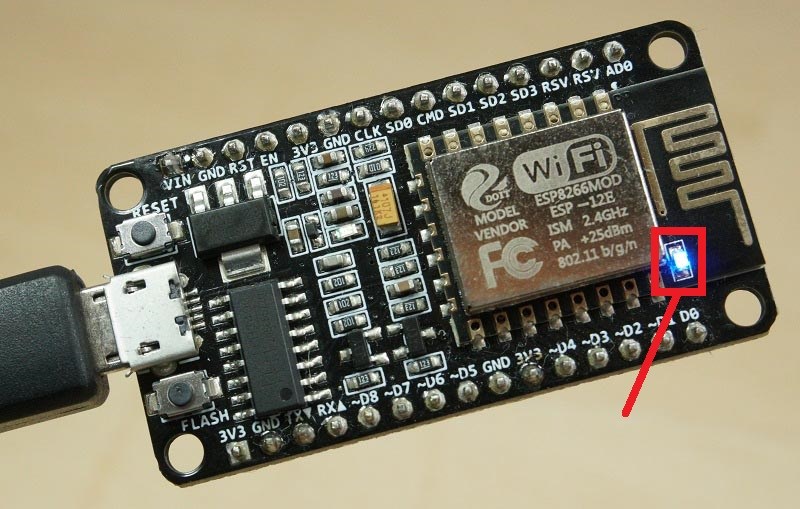
Your ESP32 or ESP8266 on-board LED should exist blinking every 500 milliseconds. Here's where the ESP32's on-board LED is located:

Here's the ESP8266 on-board LED:
Troubleshooting Tips
We've discovered some mutual bug and error messages that occur with uPyCraft IDE. Ordinarily restarting your ESP with the on-board EN/RST button fixes your trouble. Or pressing the uPyCraft IDE "Stop" button and repeating your desired action. In case it doesn't work for you, read these side by side common errors and discover how to solve them.
Error #1: You become the post-obit message:
>>> Select Serial Port could non open up port 'COM4': FileNotFoundError(ii, 'The arrangement cannot observe the file specified.', None, 2)
Or an equivalent message:
>>> could not open up port 'COM4': PermissionError(13, 'A device attached to the system is not operation.', None, 31)
Unplug, and plug back your ESP board. Then, double-check that you've selected the right serial port in theTools >Serial carte du jour. Then, click the "Connect/disconnect" button to establish a serial communication. You should at present be able to upload a new script or re-run new code.
This error might also mean that you have your serial port being used in another program (like a serial terminal or in the Arduino IDE). Double-check that you've closed all the programs that might be establishing a series communication with your ESP lath. Then, unplug and plug back your ESP lath. Finally, restart the uPyCraft IDE – endeavour to select the serial port in theTools >Series carte du jour.
Error #2: Problem uploading a new script.
>>> already in download model,delight expect.
Press the "Stop" button in uPyCraft IDE (ane or 2 times) to brand sure any code that was running stops. Later on that, press the "Download and run" button to upload the new script to your ESP board.
Error #3: After uploading a new script, if yous come across the following message:
>>> Ready to download this file,please wait! ... download ok os.listdir('.') Traceback (most recent phone call last): File "<stdin>", line i, in <module> NameError: proper noun 'bone' isn't defined Or this message:
>>> Ready to download this file,delight look! ... download ok bone.listdir('.') OSError: [Errno 98] It ways the new file was uploaded to your board successfully. Yous tin observe that it printed the "download ok" message. Press the ESP on-board "EN/RST" button to restart your board and re-run the new uploaded script from the commencement.
Error #four:Problem restarting your ESP board, running a new script or opening the serial port:
>>> Brownout detector was triggered
The "Brownout detector was triggered" error message means that there's some sort of hardware trouble. It's often related to i of the following issues:
- Poor quality USB cable;
- USB cable is besides long;
- Board with some defect (bad solder joints);
- Bad computer USB port;
- Or not plenty power provided by the computer USB port.
Solution: try a different shorter USB cable (with data wires), endeavour a unlike computer USB port or apply a USB hub with an external ability supply.
Of import: if you keep having constant bug or weird fault messages, we recommend re-flashing your ESP board with the latest version of MicroPython firmware: Wink/Upload MicroPython Firmware to ESP32 and ESP8266.
https://randomnerdtutorials.com/getting-started-micropython-esp32-esp8266/
barhamramessanies89.blogspot.com
Source: https://micropython.nxez.com/2018/11/30/getting-started-with-micropython-on-esp32-and-esp8266.html

Post a Comment for "Upycraft Open Serial Error Please Try Again Esp32"